
In a global market where food safety has become an essential condition for access to customers, retailers, and foreign markets, companies in the food industry are required to demonstrate that their products are manufactured under controlled conditions and comply with the highest international standards. For an enterprise in the Republic of Moldova that intends to export food products, the implementation and certification according to FSSC 22000 (Food Safety System Certification 22000) represents one of the most effective strategic investments in business development
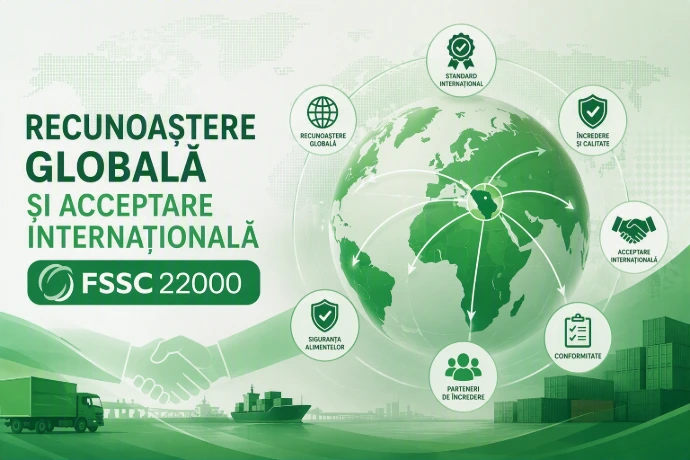
Global recognition and international acceptance
One of the most important advantages of FSSC 22000 is that the scheme is recognized by Global Food Safety Initiative (GFSI), an organization that sets the benchmark criteria for food safety standards accepted by major retail chains and producers worldwide.
For exporters, this aspect is extremely valuable. In many cases, international customers, distributors, and large retail chains require suppliers to hold a GFSI-recognized certification. A company certified FSSC 22000 can immediately demonstrate that its food safety management system meets globally accepted requirements.
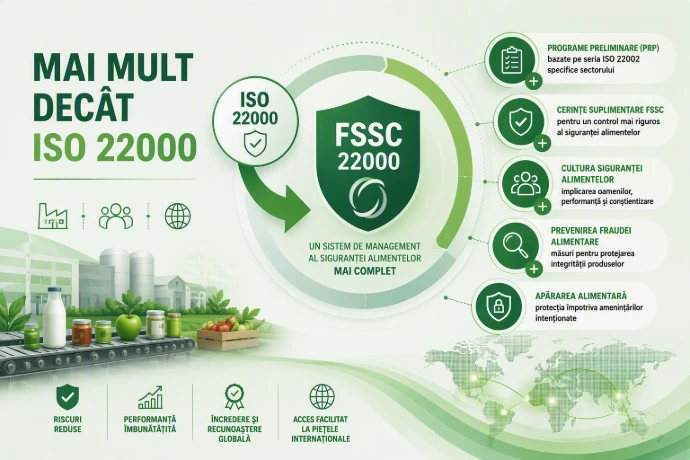
More than ISO 22000
Although ISO 22000 is an excellent international standard for food safety management, FSSC 22000 provides an additional level of assurance because it includes:
- the requirements of ISO 22000;
- sector-specific prerequisite programs (PRP) based on the ISO 22002 series;
- additional FSSC requirements regarding food safety, food safety culture, food fraud prevention, and food defense. [fssc.com]
This approach makes FSSC 22000 one of the most comprehensive food safety management systems currently available.
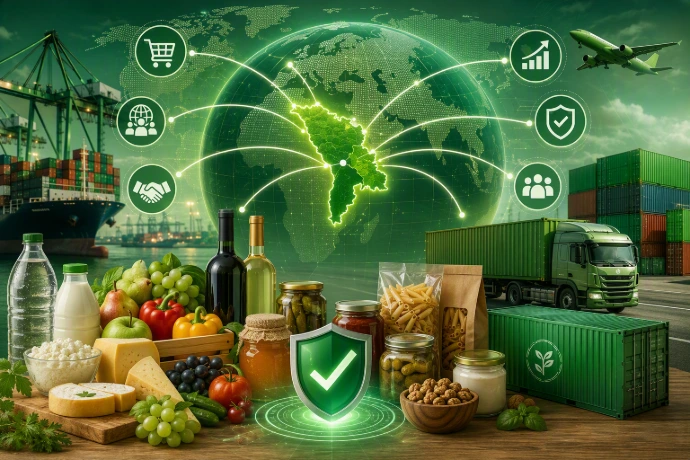
Greater export opportunities
For Moldovan producers of bottled water, soft drinks, dairy products, meat, bakery, canned goods, frozen products, or food ingredients, FSSC 22000 certification can facilitate access to the markets of the European Union, the Middle East, Asia, and North America.
Many international buyers prefer or even require suppliers to be certified according to a GFSI-recognized scheme. In the absence of this, the supplier qualification process is usually more complex, more costly, and may involve additional audits conducted directly by the client.
Reducing the number of client audits
Each audit conducted by a client consumes time, resources, and personnel. FSSC 22000 provides an independent and internationally recognized certification that reduces the need for repeated audits from various buyers.
Thus, the company can save resources and focus more on improving processes and business development.
Strengthening consumer and partner trust
In a time when food safety incidents can severely impact an organization's reputation, FSSC 22000 offers a robust framework for identifying, assessing, and controlling risks.
Certification demonstrates that the organization:
- applies HACCP principles;
- monitors food safety risks;
- has effective traceability systems;
- manages non-conformities and crisis situations;
- promotes continuous improvement.
These elements contribute to increasing trust from consumers, business partners, and authorities.
Easy integration with other management standards
Most modern enterprises implement multiple management systems simultaneously. Built on the ISO structure, FSSC 22000 can be easily integrated with:
- ISO 9001 (quality management);
- ISO 14001 (environmental management);
- ISO 45001 (occupational health and safety).
This integration reduces duplicate documentation and simplifies the management of systems.
Competitive costs and flexibility in choosing the standard
Another important argument in favor of FSSC 22000 for companies in the Republic of Moldova is the cost efficiency of certification and maintenance. Due to the existence of certification bodies that can provide local FSSC 22000 audit and certification services, total costs are often more advantageous compared to schemes such as IFS Food or BRCGS Food Safety, which frequently involve additional international resources and higher audit costs.
In addition, the three schemes are widely recognized by the international market and used to demonstrate compliance with food safety systems. In practice, many organizations choose FSSC 22000, IFS Food, or BRCGS depending on customer requirements, target markets, and their own development strategy. In numerous situations, a client requesting a certification recognized by GFSI may accept one of these schemes, which provides producers with greater flexibility in choosing the standard that offers the best balance between costs, benefits, and market access. FSSC 22000 benefits from GFSI recognition and is widely accepted by international retailers and producers. [fssc.com]
For many food enterprises in Moldova, this combination of international recognition, competitive costs, and the ability to meet the requirements of most trading partners makes FSSC 22000 one of the most advantageous options for export development and strengthening positions in foreign markets.
Alignment with the new market requirements
The new version FSSC 22000 v7, launched in 2026, includes important updates regarding preliminary programs, alignment with the latest GFSI requirements, and strengthening aspects such as sustainability and the performance of food safety management systems.
By adopting FSSC 22000, Moldovan companies demonstrate that they are ready to meet the current and future demands of the global food industry.
Conclusion
For an export-oriented enterprise in the Republic of Moldova, FSSC 22000 is not just a certification, but a strategic development tool. Global recognition, acceptance by major retail networks, compatibility with GFSI requirements, and a comprehensive approach to food safety make this system an optimal choice for organizations looking to strengthen their position in international markets.
In an increasingly competitive business environment, FSSC 22000 certification can become the differentiator that opens new business opportunities and contributes to building a solid reputation based on trust, compliance, and operational excellence.